

Why Every Pakistani Needs Sunscreen: Daily SPF for Sun, Dark Spots & Chhaiyan
Most people in Pakistan only reach for sunscreen at the beach. The truth is, Pakistan's UV levels mean that daily SPF is one of the single most impactful steps you can add to your skincare routine — summer or winter, indoors or outdoors.

- Pakistan experiences high to very high UV levels for much of the year — not just in summer.
- UVA rays can pass through glass windows — indoor skin is still exposed during the day.
- UV exposure is one of the leading causes of dark spots, chhaiyan and premature ageing on Pakistani skin.
- Most sunscreens leave a white cast on Pakistani and South Asian skin — a tinted SPF solves this.
- SPF 30 applied every morning is sufficient for most daily routines in Pakistan.
Pakistan's UV Levels — What the Numbers Mean
The UV index is a scale that measures how strong UV radiation is on any given day. A UV index above 6 is considered high risk. Above 8 is very high risk. Karachi, Lahore, Islamabad and Faisalabad regularly sit in the very high range for most of the year — not just in peak summer months.
What this means for your skin: on a typical spring or autumn day in Lahore, the UV index is high enough to cause cumulative skin damage within 20 to 30 minutes of unprotected exposure. Over months and years, this UV exposure contributes directly to dark spots, chhaiyan, uneven skin tone, and early signs of skin ageing.
This is not about fear — it is about understanding why Pakistani skin is disproportionately affected by hyperpigmentation compared to people living in lower-UV countries. The climate itself is a factor, and SPF is the most direct way to address it.
Do I Need Sunscreen Indoors?
This is one of the most common questions — and the answer is yes, with some nuance.
There are two main types of UV rays: UVB and UVA. UVB is blocked by glass, so sitting near a closed window reduces your UVB exposure. But UVA rays — the ones most associated with skin ageing, dark spots, and long-term pigmentation — can pass through glass. If you work near a window, sit in a car regularly, or spend time in a room with natural light coming in, your skin is still receiving meaningful UV exposure throughout the day.
For people who work from home, spend most of the day indoors, or live in an apartment — a daily SPF is still recommended, especially on the face. It takes 30 seconds and the long-term benefit for Pakistani skin is significant.
How UV Causes Dark Spots and Chhaiyan

UVB rays penetrate the skin's surface — the main cause of burning and long-term skin damage.
Melanin is your skin's natural response to UV exposure — it is produced to protect skin cells from radiation damage. On darker skin tones, including Pakistani and South Asian skin, this melanin response is stronger and more visible. The result is dark spots, chhaiyan, post-acne marks that darken in the sun, and an overall uneven-looking complexion.
Here is the key point many people miss: if you are using a brightening serum to improve the look of dark spots and chhaiyan, but you are not wearing daily SPF, you are working against yourself. UV rays trigger new melanin production faster than most serums can address it. SPF and a brightening serum work together — one prevents new damage, the other helps address existing uneven tone.
UV rays trigger melanin production daily. Dark spots deepen. Chhaiyan becomes more visible. Brightening serums struggle to keep up with ongoing UV damage.
UV rays are blocked before they reach skin cells. New dark spots are less likely to form. Brightening serums work more effectively on existing uneven tone.
Skin that is consistently protected from UV looks clearer and more even. Existing dark spots may appear less pronounced when new ones are no longer forming.
Brightening serum in the morning + SPF on top = the most effective combination for improving the appearance of dark spots and chhaiyan on Pakistani skin.
The White Cast Problem — Why Most People in Pakistan Skip SPF

Tinted SPF blends naturally into Pakistani and South Asian skin tones — no chalky residue.
Ask any Pakistani why they do not wear sunscreen daily and the answer is almost always the same: it leaves a white cast. This is a real and valid concern — most sunscreens on the market are formulated for lighter skin tones and leave a chalky, grey-white residue that looks unnatural on Pakistani and South Asian skin.
The solution is not to skip SPF — it is to choose the right formula. Tinted SPF formulas are specifically designed to blend into medium to deeper skin tones. They provide the same UV protection without the white cast, and many tinted formulas also help even out skin tone slightly, making them genuinely wearable for daily use.
Modern lightweight formulas often blend more invisibly than older heavy sunscreens.
The Right Sunscreen for Pakistani Skin
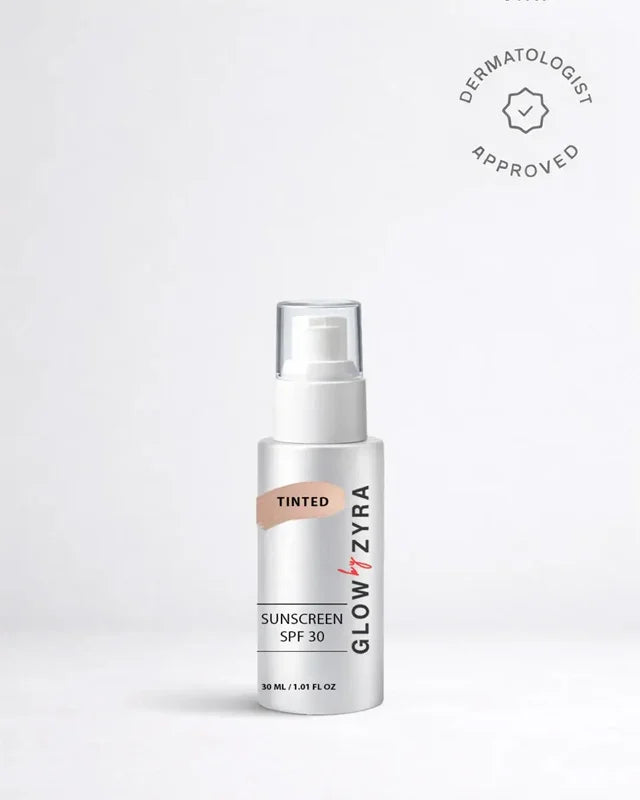
The Tinted Sunscreen SPF 30 by Glow by Zyra is specifically formulated for Pakistani and South Asian skin tones. It provides broad-spectrum UV protection with a sheer, natural-looking tint that blends into the skin rather than sitting on top of it. Lightweight enough for Pakistan's heat and humidity, and dermatologist-tested for daily use.
How to Use Sunscreen Correctly
Most people who do wear sunscreen are not applying it correctly — which reduces its effectiveness significantly.
SPF 30 vs SPF 50 — Which Should You Use?

SPF is a daily habit — not just a beach product.
For most daily use in Pakistan — commuting, working indoors, running errands — SPF 30 is a good daily option for most routines when applied correctly. SPF 30 blocks approximately 97% of UVB rays. SPF 50 blocks approximately 98%. The difference in actual protection is smaller than most people assume.
The bigger factor is consistent, correct application. An SPF 50 applied too thinly offers less real protection than an SPF 30 applied in the right amount. For extended outdoor time — spending a full day outside, going to the beach, or playing sports — SPF 50 or higher is worth the upgrade.
For a daily skincare routine in Pakistan's cities, SPF 30 applied correctly every morning covers you well.
Common Sunscreen Mistakes in Pakistan
| Mistake | Why it happens | Fix |
|---|---|---|
| Skipping SPF entirely | White cast, feels heavy, "I'm indoors anyway" | Use tinted SPF — no cast, lightweight |
| Only using SPF in summer | Think UV is only a summer problem | UV is year-round in Pakistan — daily habit |
| Applying too little | Trying to avoid white cast or save product | Half a teaspoon for face — use enough |
| Skipping on cloudy days | Assume clouds block all UV | Clouds block some, not all — keep the habit |
| Using SPF moisturiser only | Think SPF in moisturiser is enough | SPF in moisturiser is rarely applied in sufficient quantity — use a dedicated SPF |